Private mould development
The cap is the only component where tooling sets the floor.
A bottle can be decorated without opening a mould, and a box can be printed without one. A cap cannot be printed into existence — it has to be cut. That is why a custom cap behaves differently from everything else on the brief: the floor is not set by labour per unit, but by a fixed cost that has to be carried by the run.
Our floor for private mould development is 1,000 to 1,500 pieces. Below that the tooling share of the unit cost stops making sense, so we publish the floor rather than bury it inside a quotation you cannot unpack. Where you land inside that range is decided by five things, and all five are visible before anyone cuts steel.
What moves the floor
Five decisions, and what each one costs you in quantity
| Closure format | Parts | Floor | What drives it |
|---|---|---|---|
| Mono-block cylindrical cap, self-colour | 1 | 1,000 | One cavity, no shroud, no secondary finish |
| Cap with a separate shroud or inner shell | 2 | 1,200 | Two moulds to cut and two T1 approvals |
| Sculpted or faceted outer wall | 1–2 | 1,300 | Deeper cavity work and a slower cycle |
| Plated or soft-touch outer finish | 1 | 1,500 | Finishing yield loss charged to the batch, not the unit |
These are floors for the mould, not preferences. A run below the floor is not refused on principle — it is refused because the mould would arrive at your unit price in a way you would not accept if you saw the arithmetic.
Why a mould has a floor at all
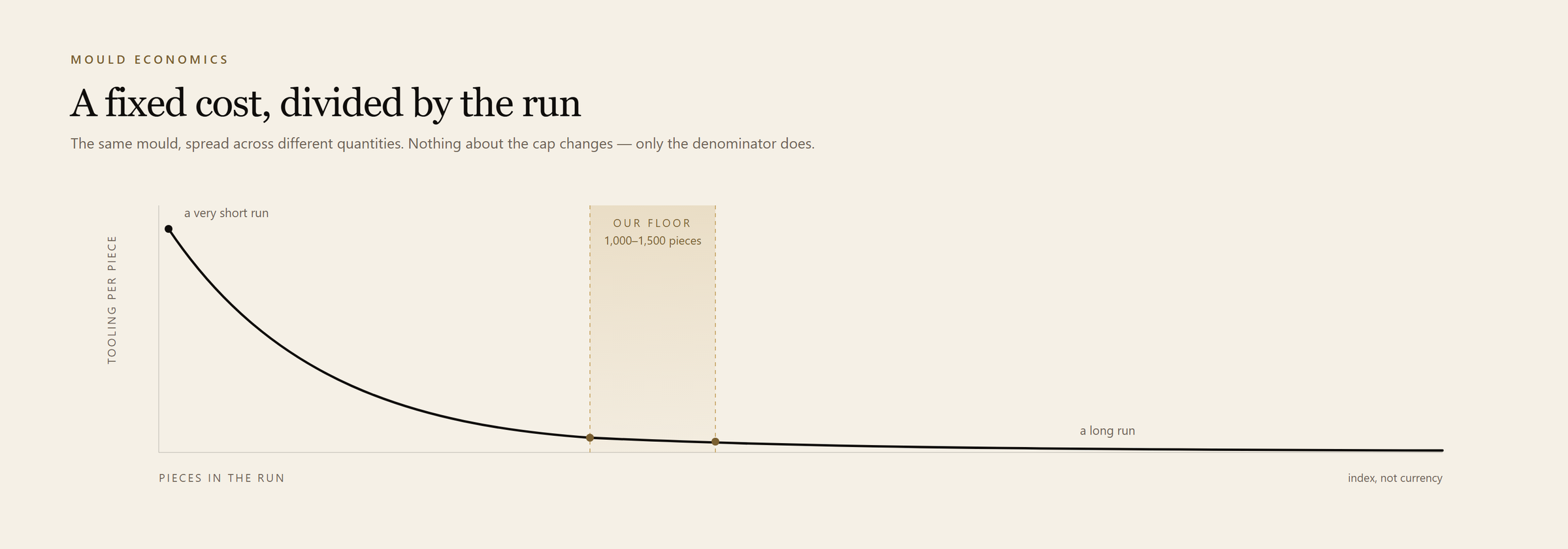
Fixed cost, divided by the run
It is a division problem
A mould is a fixed cost. Cut it for 5,000 pieces and it is a small number per unit. Cut the same mould for 800 and the identical cost lands on a sixth of the volume. Nothing about the cap got more expensive — only the denominator changed.
Suppliers who quote a low minimum on a custom closure are usually quoting a mould they already own, or an existing shape they will relabel as yours. Both are legitimate. Neither is a private mould.
What we will not do
We do not cut a mould before the neck standard is agreed in writing. A cap cut against the wrong neck finish fits nothing, and the mould cannot be adjusted afterwards — it can only be recut.
We also do not approve a cap from a render. The render is a conversation; the T1 shot is the decision. You hold the prototype before steel is cut.
The sequence
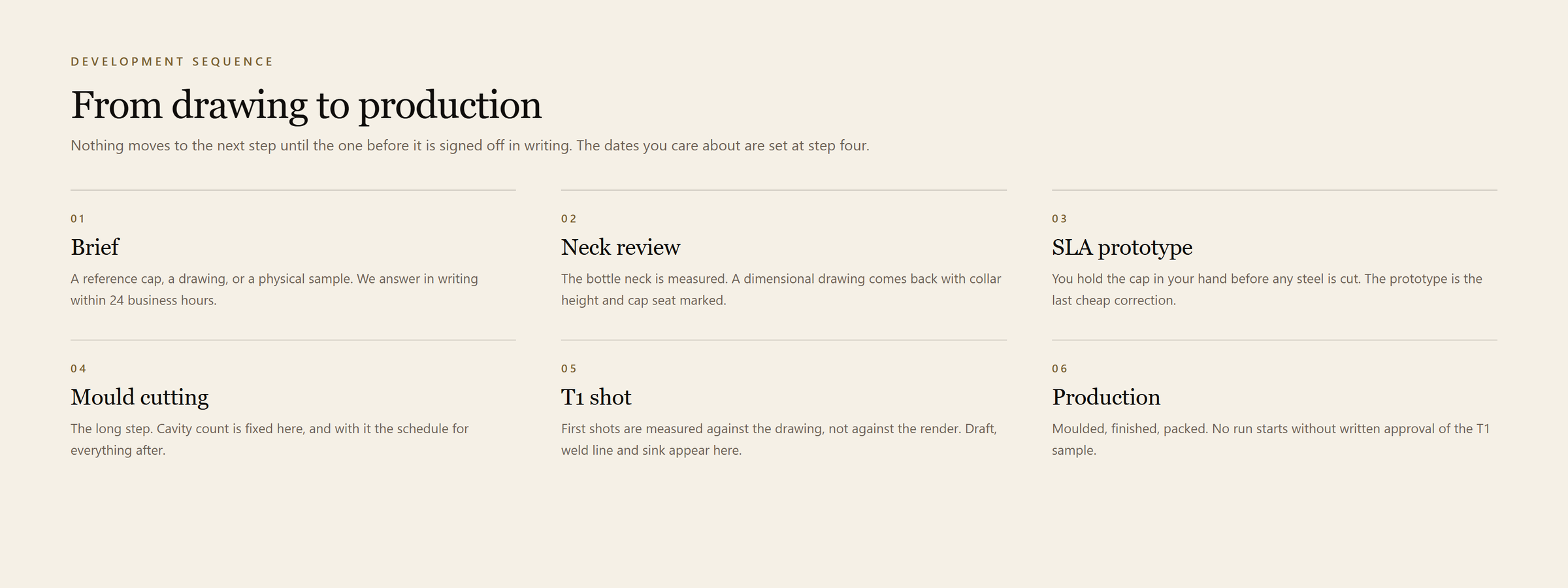
Six steps, and what is owed at each
| # | Step | What you provide | What comes back |
|---|---|---|---|
| 1 | Brief | Reference cap, drawing, or a physical sample | Written read on whether the format is viable at your quantity |
| 2 | Neck and collar review | The bottle, or its neck drawing | Dimensional drawing showing neck finish, collar height and cap seat |
| 3 | SLA prototype | Approval to model | A physical prototype you can hold against the bottle |
| 4 | Mould cutting | Signed prototype and purchase order | Cutting begins; this is the long step |
| 5 | T1 shot | — | First shots measured against the drawing, not against the render |
| 6 | Production | Written approval of T1 | Moulded, finished, packed |
Dates are confirmed per project in the quotation. Mould cutting dominates the schedule; the steps after it are measured in days.
Where caps actually fail
Four dimensions that decide whether it works
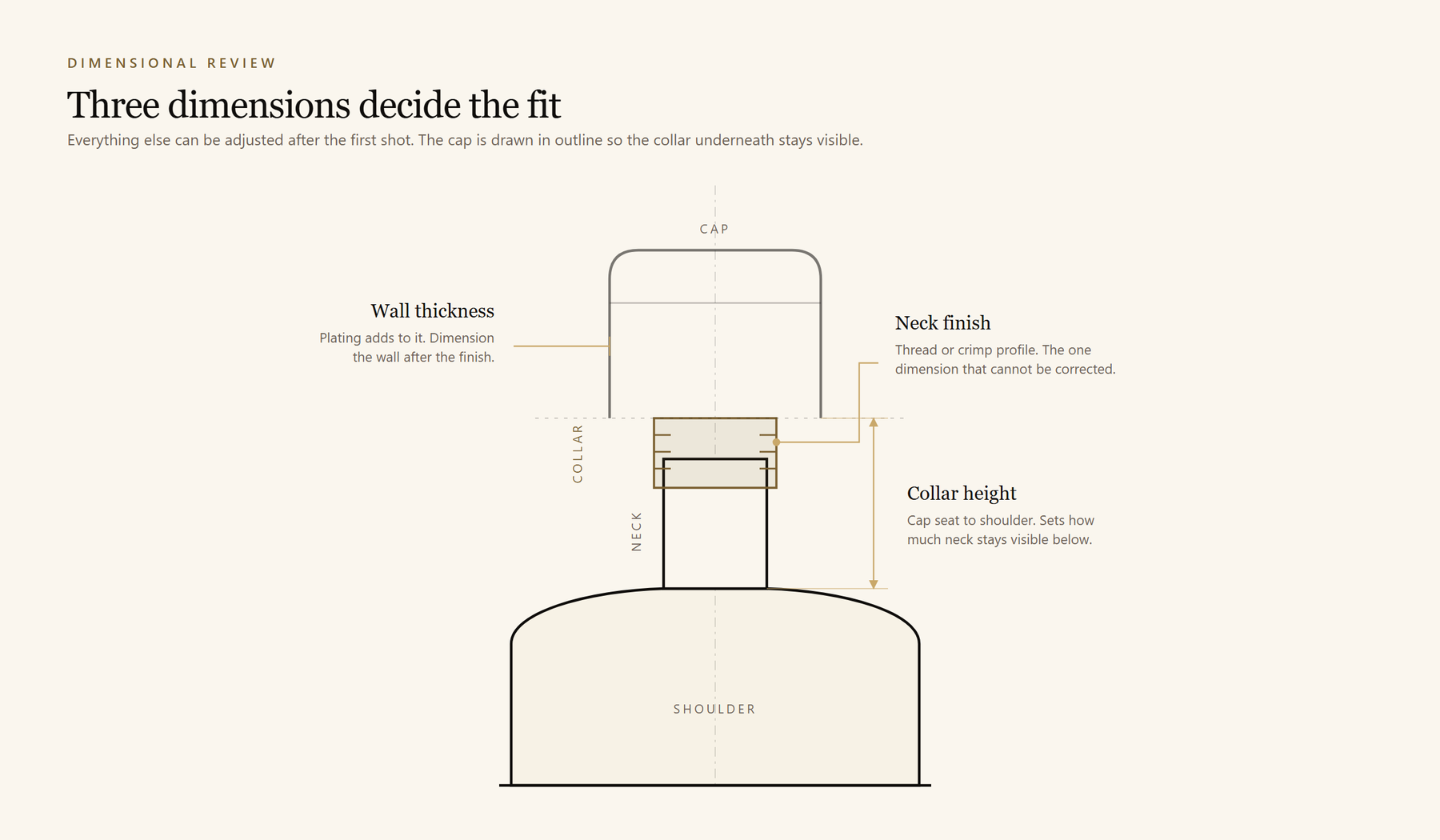
Neck finish
The thread or crimp profile. Get this wrong and the cap fits nothing — it is the one dimension that cannot be corrected later, only recut.
Collar height
The distance from the shoulder to the cap seat. Too little and the cap sits proud of the bottle; too much and it swallows the shoulder line.
Cap-to-shoulder gap
The visible line between cap and glass. This is the detail buyers notice first on a shelf, and it is set by two tolerances stacking, not one.
Weight balance
A heavy cap on a light bottle reads as cheap the moment it is picked up. The target cap weight has to be set against the filled bottle, not on its own.
Failure modes
Five ways a cap project goes wrong
- Mould cut before the neck standard is confirmed. The most expensive correction available, because the only fix is a new cavity.
- Render approved instead of T1. A render has no draft angle, no weld line and no sink. Those three appear on the first shot.
- Plating specified before wall thickness is fixed. Plating adds thickness; a wall dimensioned without it comes back oversized.
- One cavity sized for a quantity that needed two. Below the floor, two cavities can cost less per unit than one cavity run short.
- Cap weight set without checking the pump. An over-tall cap can foul the actuator, which is a design problem discovered after the mould is cut.
To quote
What to send
- A physical sample, or a drawing with the neck finish named.
- The bottle you intend to use, or its neck dimension.
- Target cap weight and finish, if you have a reference in mind.
- Intended quantity for the first run, and whether a second run is planned.
Without a sample or a drawing we can still talk about direction, but not about a mould. A cap cannot be quoted from a photograph.
Questions
Before you commit
Can a mould be cut below 1,000 pieces?
It can physically be cut at any quantity. What does not work is the arithmetic: the fixed tooling cost is divided across too few units, so the per-unit price stops being something you would agree to. If your first run is short, the honest route is a stock closure now and a private mould when volume supports it.
Can two fragrances share one cap mould?
Yes. The mould is tied to the closure geometry, not to the scent. Two fragrances can share a cap as long as the bottle neck standard is identical, which is usually the thing that decides it rather than the fragrance.
Can you match a cap I already have?
Send a physical sample and we will measure it. A photograph is not enough — wall thickness, draft and the internal fitment are not visible in an image, and those are what the mould is cut from.
How long does development take?
It is confirmed per project in the quotation, because mould cutting dominates and cavity count changes it. The prototype and T1 stages each take days rather than weeks; the cutting step is the one that sets the date.